Page 2 of 3

Re: How might beraishit be absolute, given the shwa on the bet?

Posted: Wed Nov 06, 2019 6:40 pm
by ralph
Jemoh66 wrote: FYI. The Jewish scholars who translated the LXX saw no vowel there.

ΕΝ ΑΡΧΗ ἐποίησεν ὁ θεὸς τὸν οὐρανὸν καὶ τὴν γῆν.
I'm sure there is no vowel 'cos I trust the masoretes to get the first thing right, But putting that aside and looking at the greek.. you say the greek reflects that too.

greek ΕΝ ΑΡΧΗ translation from google "In principle"

(putting aside a spelling issue that currently puzzles me there 'cos i'd have thought it'd be translated "in principal" but anyhow that's an aside)..

the greek doesn't have either an indefinite article, or a definite article.. So how are you concluding whether the greeks saw a vowel there or not?

"In principal" seems neutral on whether it's definite or not.

doesn't it? (like how is "in principal" not neutral?)

Re: How might beraishit be absolute, given the shwa on the bet?

Posted: Wed Nov 06, 2019 9:42 pm
by Jason Hare
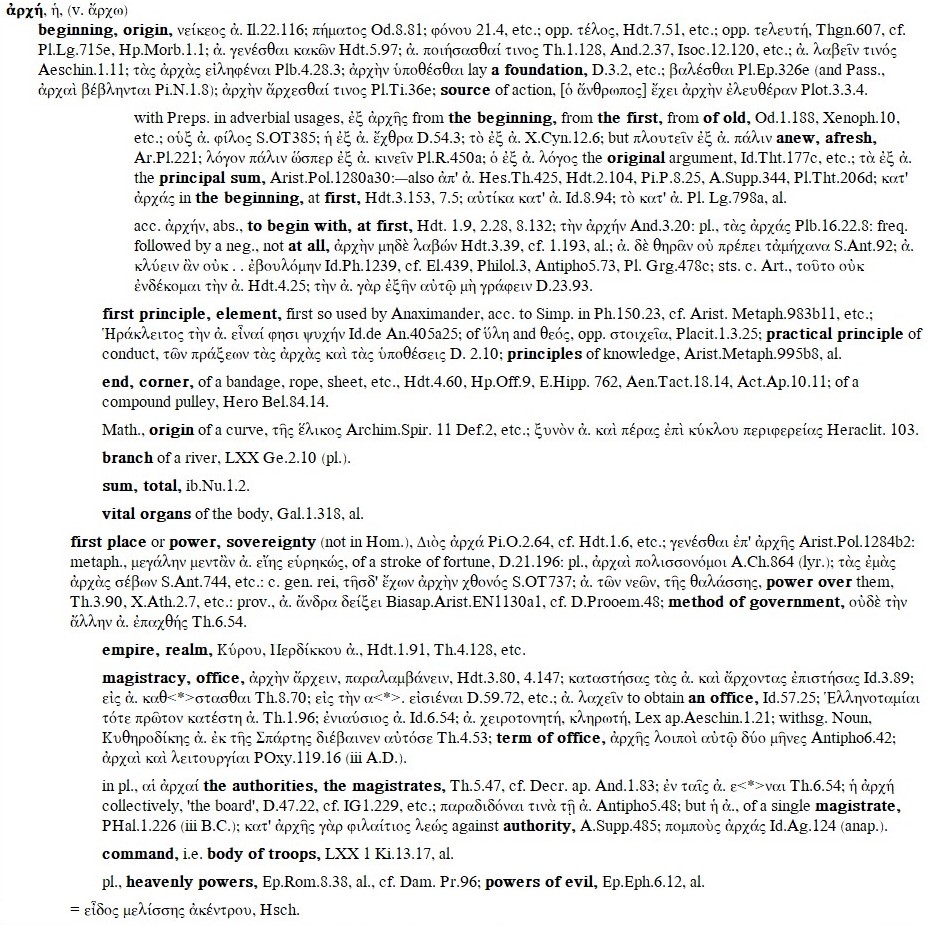
ἐν ἀρχῇ means "in the beginning." It doesn't mean "in principle," no matter what Google Translate (the source of all sources for proper translation, of course) has to say about the matter. We know what ἀρχή means from its uses in Greek texts, not from an automated translation engine.

Image

Re: How might beraishit be absolute, given the shwa on the bet?

Posted: Thu Nov 07, 2019 8:41 pm
by ralph
Jason Hare wrote:ἐν ἀρχῇ means "in the beginning." It doesn't mean "in principle," no matter what Google Translate (the source of all sources for proper translation, of course) has to say about the matter. We know what ἀρχή means from its uses in Greek texts, not from an automated translation engine.
<reference picture included>
<snip>
if the forum had a like button i'd click it.. good stuff, thanks. I don't know greek and have not studied greek. Great reference pic you posted there.

Re: How might beraishit be absolute, given the shwa on the bet?

Posted: Fri Nov 08, 2019 7:55 am
by Kirk Lowery
Jason,

Is your quote from BDAG, LSJ, or...?

Re: How might beraishit be absolute, given the shwa on the bet?

Posted: Fri Nov 08, 2019 8:08 am
by ralph
Kirk Lowery wrote:Jason,

Is your quote from BDAG, LSJ, or...?
Great question..

And @Jason, it's great that you showed a picture from a reference, but it is really important that you name a reference when quoting one or showing an image from one.. Thanks. But stlll useful that it was at least a reference work.

Re: How might beraishit be absolute, given the shwa on the bet?

Posted: Fri Nov 08, 2019 9:35 am
by Jason Hare
Kirk Lowery wrote:Jason,

Is your quote from BDAG, LSJ, or...?
It's from Diogenes, which I think uses just Liddell. I saved the image as arche-liddell.jpg, so I thought that would come through (but it didn't). Should have mentioned that.

Correction: Just checked and found that they use the full Liddell-Scott-Jones.

Re: How might beraishit be absolute, given the shwa on the bet?

Posted: Wed Jul 07, 2021 9:29 pm
by ralph
Jason Hare wrote: Wed Nov 06, 2019 9:42 pm ἐν ἀρχῇ means "in the beginning."
Thanks.

Do you have any idea what "Jemoh" is talking about when he says "The Jewish scholars who translated the LXX saw no vowel there."

Is he just saying the text has a shva (which obviously I agree with anyway so is not really saying anything)
Jemoh66 wrote: the definite article would contract to a pathaq and be assumed by the preposition.
If we say Bvait David בבית דוד , (in the house of david), then it's translated as definite(despite the shva on the first bet), because the first noun (bait), is in the construct. The preposition isn't that relevant.

I think ducky takes breishit as construct and hence definite.

I wonder if Jemon66 or anybody has any example of an absolute noun with a preposition with a shva, but where the noun is translated as definite?

Not sure why Jemoh says "the definite article would contract to a pathaq". There is no patach there.

I'm curious how one argues that it's "in the beginning" without arguing that it's construct.

Re: How might beraishit be absolute, given the shwa on the bet?

Posted: Thu Jul 08, 2021 7:34 pm
by ducky
Construct states are not definite by default.
(even though, the fact that the noun is constructed, it is described, and by that, it is also automatically defined).

**
If the בראשית starts with Sheva, it is hard not to see it as part of a construction.

The question is how.

There is the suggestion of the verb ברא (and beyond it) acts as the second part of the construction.
There is a suggestion of this ראשית has some sort of a "missing word", such as: בראשית הימים for example, but there was no need for the הימים to be written since the word בראשית alone would give the general meaning of the beginning of time/days/creation and so on...
It is something like in Isa. מראשית עד אחרית which this word is indefinite but is understood with the meaning of "time".

****
In your other post, you wrote about ראשית comes in a definite state.
but I think that when it comes to fruits, ראשית בכורים for example, the ראשית itself took over the whole combination. and therefore, it acts as an absolute word, and in that case, it should come in a definite state. This happened with this meaning because we can guess this was a very popular combination of words up until it was enough to say only the first part of it that it would be understood with the full meaning.

Re: How might beraishit be absolute, given the shwa on the bet?

Posted: Sun Jul 11, 2021 3:20 am
by ralph
ducky wrote: Thu Jul 08, 2021 7:34 pm Construct states are not definite by default.
Thanks.. do you have any examples of that? (besides Psalm 81:6 שְׂפַת לֹא יָדַעְתִּי אֶשְׁמָע (a language {that/אשר} I didn't know).

ducky wrote: If the בראשית starts with Sheva, it is hard not to see it as part of a construction.
Of course. For example in an earlier post I mentioned. בבית דוד buh-vait david.
ducky wrote: The question is how.
do you mean the question is how can beraishit be a construct?

actually the question in this thread is how might beraishit be absolute(Given the shwa on the bet)

You mention two possibilities for beraishit being construct. The idea that Bara is part of the construct. Or, alternatively, the idea that beraishit has an implied noun(missing word) with it.

You give two examples of implied noun(missing word).


בראשית הימים (does that occur in tanach? I don't see it with this search of beraishit)

http://sparks.simania.co.il/bibleSearch ... ery=בראשית

And you mention
Isa 46:10 מראשית עד אחרית

With the word Beraishit, does it have an absolute form? Is the absolute form the same as the construct form?

Do you have any example of a noun that has a different construct form from absolute form.. And then for that noun do you have an example where it is in construct with a "missing word"?

ducky wrote: In your other post, you wrote about ראשית comes in a definite state.
but I think that when it comes to fruits, ראשית בכורים for example, the ראשית itself took over the whole combination. and therefore, it acts as an absolute word, and in that case, it should come in a definite state. This happened with this meaning because we can guess this was a very popular combination of words up until it was enough to say only the first part of it that it would be understood with the full meaning.
I agree.

Note that when I say "implied noun", that's what you mean by missing word (at least in this case).

And I guess there's a question of whether the word "construct" applies when you have an implied noun?

Does the one noun that appears, appear in the absolute form, or the construct form?

On a related note.

Do you look at all constructs as involving a "missing word"?


For example a construct of beraishit [מתי/when] bara there's that connecting word / "particle", missing.

When it comes to two nouns. Beit David There's kind of a missing connecting word there Shel. Though Biblical Hebrew didn't have a word "Shel".

So I suppose to define what construct is it'd have to be either when you have 2 or more nouns one after the other, in a chain. Or, when you have a noun and a verb and a missing connecting word. Or a noun on its own but that has an implied noun "following" it.
Re: How might beraishit be absolute, given the shwa on the bet?

Posted: Sun Jul 11, 2021 8:03 am
by Isaac Fried
Ducky writes
There is a suggestion of this ראשית has some sort of a "missing word", such as: בראשית הימים for example, but there was no need for the הימים to be written since the word בראשית alone would give the general meaning of the beginning of time/days/creation and so on...
How could it be בראשית הימים even before there were ימים?

Isaac Fried, Boston University
www.hebrewetymology.com